

 EN
EN

Berita Industri
Disposable Purse-String Suture Device: Components, Sizing & Supplier Guide
The Role of Purse-String Suturing in Open Gastrointestinal Surgery
In open gastrointestinal surgery, few steps are as technically consequential as purse-string suture placement. The purse-string suture forms a continuous encircling stitch around the open end of a hollow organ — most commonly the bowel or rectal stump — drawing the tissue edges closed around the trocar of a circular stapler's anvil. When tied correctly, it creates the tissue cuff that makes a secure, leak-resistant anastomosis possible.
Performed manually with a needle and thread, purse-string suturing is time-consuming and demands consistent tension and bite depth across the full circumference of the tissue. Any irregularity — uneven bites, loosening under tension, or inadequate tissue incorporation — increases the risk of anastomotic leakage, one of the most serious complications in colorectal and upper GI reconstruction. Purpose-built instruments address these limitations directly by standardizing the suture placement process and reducing the procedure to a controlled, repeatable sequence.
As part of a complete gastrointestinal stapling workflow, the purse-string device works in close coordination with disposable circular staplers to enable precise, reproducible end-to-end or end-to-side anastomoses across a range of bowel diameters and surgical indications.
What Is a Disposable Purse-String Suture Device?
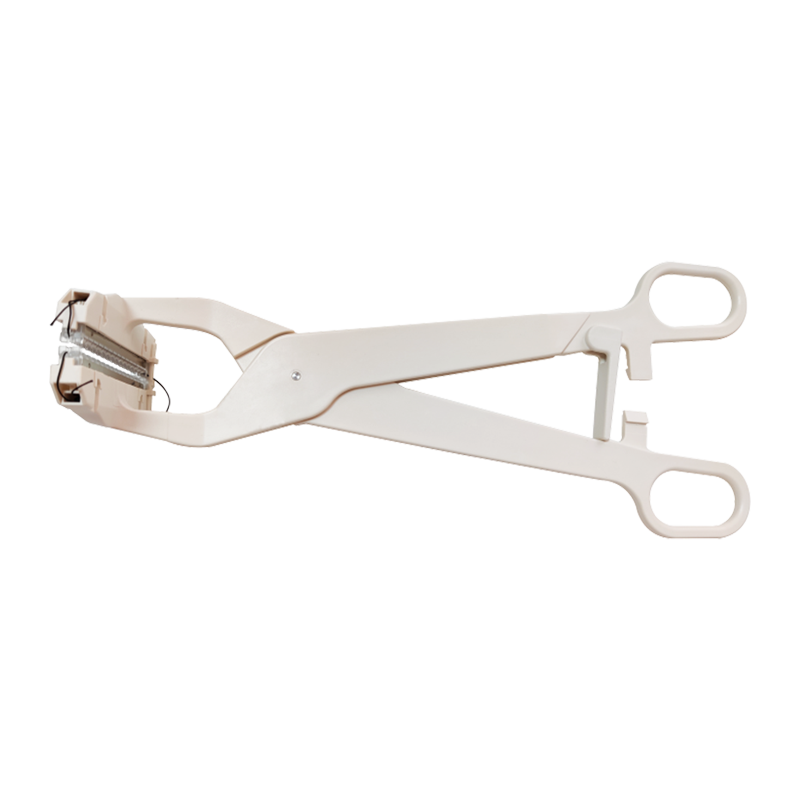
A disposable purse-string suture device is a single-use surgical instrument engineered to place a circumferential purse-string suture in open gastrointestinal procedures with consistent bite depth, spacing, and tension. It replaces the manual suturing technique with a mechanical process that reduces operative time and minimizes variability between individual surgeons or cases.
The device consists of the following primary components:
- Upper and lower clamping bases — The two opposing jaws that grip the bowel end and position the tissue for staple penetration. Designed to distribute clamping force evenly across the full effective suturing length.
- Upper and lower locking teeth — Interlocking mechanisms that hold the clamping bases securely in the closed position during firing, preventing tissue slip and maintaining consistent bite geometry.
- Safety lever — A pre-fire safety mechanism that prevents accidental actuation during positioning, ensuring the instrument is only fired when the surgeon confirms correct tissue placement.
- Staple cartridge assembly — The active suturing component, consisting of a staple holder, staple holder retaining plate, staples, and a staple pusher. Upon firing, the pusher drives staples through the tissue in a uniform pattern that anchors the purse string in position.
- Purse string — The suture thread pre-loaded into the device, which passes through the tissue with each staple placement and remains available for tightening once the device is removed and staples are separated.
After firing, the staples and purse string smoothly separate from the device, leaving the suture ends accessible for manual tightening. The tissue is drawn closed around the anvil trocar, forming the secure tissue cuff required for the subsequent circular stapler firing.
45 mm vs. 60 mm: Choosing the Right Cartridge Size
The staple cartridge assembly is available in two sizes — 45 mm and 60 mm effective suturing length — corresponding to different bowel diameters and anatomical working environments. Selecting the correct size is a prerequisite for achieving complete, even tissue incorporation around the full circumference of the organ end.
| Cartridge Size | Effective Suturing Length | Typical Application | Anatomical Consideration |
|---|---|---|---|
| Standard | 45 mm | Small bowel anastomosis, narrower bowel segments, pediatric or low-diameter cases | Matched to smaller organ circumferences; ensures complete closure without excess tissue redundancy |
| Extended | 60 mm | Colorectal anastomosis, sigmoid or transverse colon, wider rectal stump | Accommodates larger-diameter bowel ends; reduces risk of incomplete purse-string coverage |
Undersizing the cartridge relative to bowel diameter results in incomplete staple coverage, requiring supplemental manual suturing that negates the efficiency advantage of the device. Oversizing creates excess tissue that can interfere with the tightening step or lead to uneven purse-string closure. Intraoperative measurement of the bowel end diameter, combined with pre-operative imaging data, informs the correct cartridge selection in the majority of cases.
Key Performance Requirements for Reliable Purse-String Closure
The clinical value of a purse-string suture device depends on consistent performance across three critical functional parameters. Instruments that underperform on any of these criteria introduce variability that the manual suturing technique was meant to eliminate.
Suturing consistency across the full effective length is the primary performance criterion. Each staple in the sequence must penetrate to a uniform depth and spacing to create an even suture line. Inconsistent bites — whether too shallow, too deep, or unevenly spaced — create zones of weakness in the purse-string that compromise the tissue seal after tightening.
Clean separation of staples and purse string from the device after firing is equally important. If the suture or staples catch on the instrument during removal, the surgeon must manipulate the device under tension, risking tearing the placed sutures or displacing the tissue from the intended position. A well-engineered release mechanism ensures that the device withdraws smoothly without disturbing the newly placed purse string.
Smooth, controlled purse closure upon tightening is the final functional requirement. Once the device is removed and the anvil is positioned, the surgeon draws the purse-string ends together to gather the tissue evenly around the trocar shaft. The suture must run freely through the tissue without fraying, knotting, or cutting through at the staple interface. The result — a uniform, secure tissue cuff — directly determines the integrity of the subsequent anastomosis.
Disposable Design: Clinical and Operational Advantages
The shift from reusable to disposable surgical instruments across gastrointestinal surgery has been driven by a combination of infection control requirements, regulatory pressure, and operational efficiency. For purse-string devices specifically, the single-use design addresses several practical limitations of reusable alternatives.
Reusable instruments require validated cleaning, disinfection, and sterilization cycles between cases. Residual organic material in the staple cartridge assembly — a complex, multi-component structure with tight tolerances — is difficult to remove reliably through standard reprocessing. Incomplete decontamination carries cross-infection risk, a concern that has become a central focus of hospital infection prevention programs globally.
Disposable devices arrive sterile, individually packaged, and ready for immediate use. There is no reprocessing labor, no cycle validation requirement, and no degradation of mechanical performance from repeated use cycles. For high-volume surgical departments, the elimination of instrument reprocessing logistics also reduces scheduling friction between cases.
From a per-case cost perspective, disposable purse-string devices are priced to be cost-competitive with the total cost of reprocessing a reusable equivalent — once labor, validation, consumable cleaning agents, and instrument repair costs are factored in. For institutions that have already standardized on disposable surgical instruments across their GI stapling portfolio, the single-use purse-string device integrates naturally into existing procurement and workflow systems.
What to Look for in a Purse-String Stapler Manufacturer
For surgical procurement teams and hospital group purchasing organizations sourcing disposable purse-string suture devices at scale, supplier qualification goes beyond product specifications. The manufacturing environment, quality system, and regulatory compliance posture of the supplier directly affect product consistency across production runs and long-term supply reliability.
The following criteria form the foundation of a credible supplier evaluation:
- ISO 13485 certification — The baseline quality management system standard for medical device manufacturers. Verify that the certificate is current, scope-appropriate, and issued by an accredited body. ISO 13485 certification confirms that the manufacturer's design, production, and post-market surveillance processes meet internationally recognized requirements.
- CE marking and relevant market authorizations — For export to Europe, CE marking under the EU Medical Device Regulation (MDR) is mandatory. For other markets, verify that the manufacturer holds the appropriate national registrations. A supplier with multiple active market authorizations demonstrates a sustained regulatory compliance capability.
- Sterility and biocompatibility documentation — Disposable surgical instruments must be validated for sterility (typically EO sterilization with validated cycle parameters) and biocompatibility per ISO 10993. Request test reports, not just certificates.
- OEM and specification customization capability — Procurement teams with specific size, material, or labeling requirements should confirm that the manufacturer can accommodate custom specifications without compromising quality system compliance. Review sample lead times and artwork approval processes before committing to a production run.
- Production consistency and batch traceability — Ask for evidence of statistical process control or equivalent quality monitoring across production batches. Lot traceability from raw material to finished device is a prerequisite for effective post-market vigilance.
- Supply chain and lead time reliability — For time-sensitive surgical departments, supplier lead time commitments and safety stock policies matter as much as product quality. Evaluate the manufacturer's track record across existing customers in comparable markets.
Guanchuang Medical holds ISO 13485 certification and CE approval, with an established export track record across Southeast Asia, the Middle East, South America, and Russia. To request product specifications, technical documentation, or a commercial quotation for disposable purse-string suture devices, contact our team directly.

- Tautan Cepat
- About Us
- Quality
- Service
- News
- Contact us
- Produk kami
- Instrumen Laparoskopi Endoskopi Sekali Pakai
- Penutupan Luka Sekali Pakai
- Instrumen Bedah Toraks
- Instrumen Bedah Listrik
- Buka Instrumen Bedah
- Instrumen Bedah Anorektal Urin
- Instrumen Bedah Gastroenterologi
- Peralatan Bantu Medis
- Alat Persiapan Darah
- Hubungi kami
- Tel:+86-519-69878833
- Phone:+86-13584319056
- E-mail:[email protected]
- Address:Gedung 2D, 2C dan 3C, Taman Perintis Teknologi Sains Wujin, Jalan Mingxin Tengah No. 256, Kota Hutang, Distrik Wujin, Changzhou, 213164 Jiangsu P.R. Cina

